
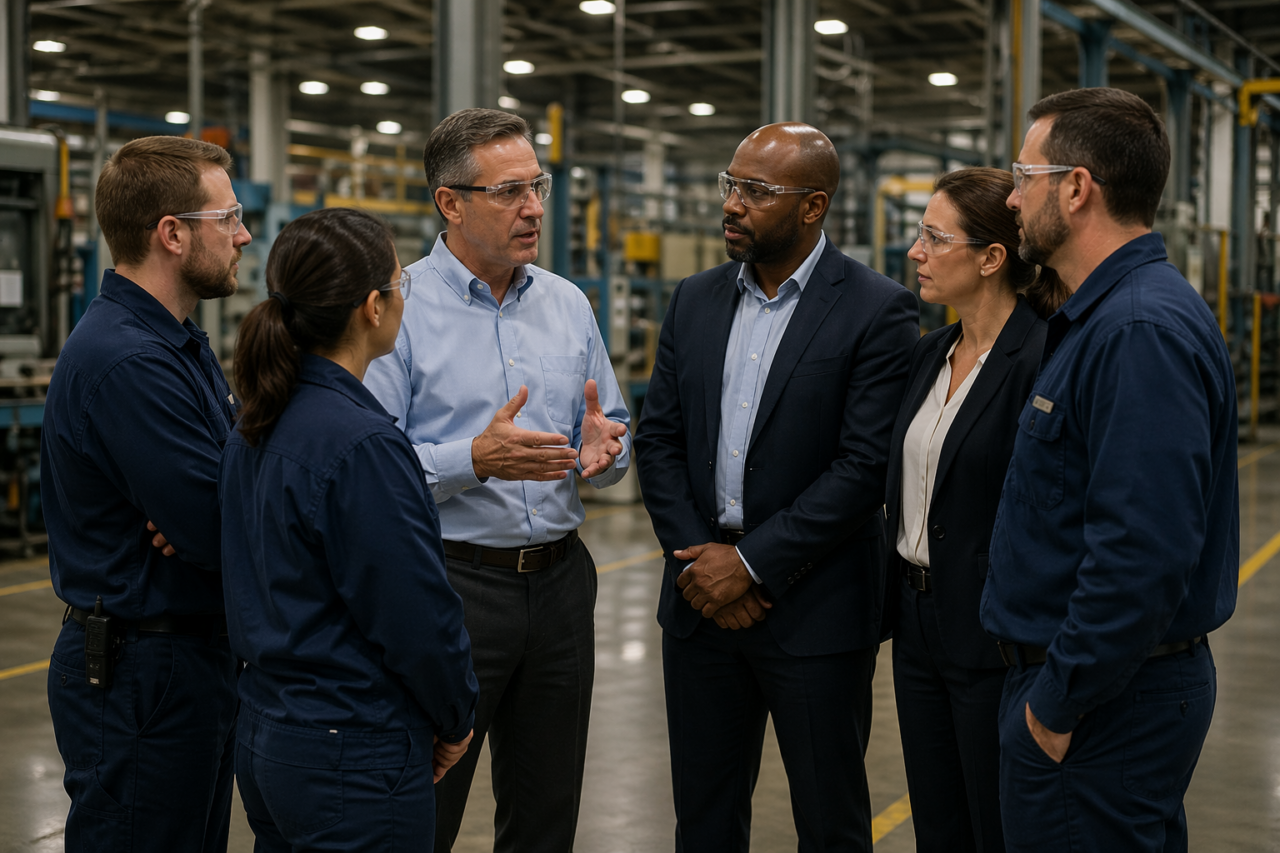
When manufacturing leaders begin hearing concerns about workplace culture, the conversation often turns quickly toward employee attitudes or engagement.
Leaders may wonder whether employees are fully committed, whether communication between teams has weakened, or whether morale has declined across the floor.
These concerns are understandable. But culture problems rarely begin with employees. More often, they begin with leadership.
Culture Reflects Leadership Behavior
In manufacturing environments, culture develops from the daily interactions between leaders and their teams.
Employees observe how decisions are made. They notice how leaders communicate with one another. They see how accountability is handled when problems arise — and whether the stated values of the organization match the actual behavior of the people running it.
Over time, these patterns shape how people behave across the organization. If leaders communicate clearly, collaborate across departments, and address challenges openly, those behaviors become part of the culture. If leadership communication becomes inconsistent or fragmented, the culture reflects that as well.
Culture Problems Are Often Symptoms
When organizations experience culture challenges, leaders sometimes attempt to address them through programs or initiatives — new communication tools, engagement surveys, team-building activities.
While these efforts can help at the margins, they rarely solve deeper culture issues on their own. That’s because culture problems are usually symptoms of leadership dynamics rather than isolated behavioral problems that can be trained away.
When leadership alignment improves, culture often strengthens naturally — without a formal initiative.
If your organization has been discussing culture and the conversations keep circling back to the same issues, it may be worth examining the leadership dynamics underneath them. A 30-minute Leadership Clarity Call can help you identify what’s actually driving what you’re seeing.

Leadership Alignment Sets the Tone
Employees take cues from how leadership operates at every level.
If leaders across departments share consistent expectations and communicate clearly with one another, those behaviors tend to cascade throughout the organization. People know what’s expected. They know how decisions get made. They can see that the people above them are working together.
But if leaders appear disconnected or misaligned — even subtly — employees sense that quickly. In manufacturing environments, where coordination and trust across shifts and departments are essential, even small leadership disconnects can influence culture significantly and persistently.
Culture Improves When Leadership Evolves
Organizations that address culture challenges successfully usually start by reflecting on leadership dynamics rather than on employee behavior. They examine how leaders communicate, how decisions are made, and how accountability is handled across departments.
These conversations often reveal that culture improves naturally — and sometimes quickly — when leadership alignment strengthens. The culture was always going to reflect the leadership. The work is making sure the leadership is worth reflecting.
Where This Usually Leads
If your organization has been talking about culture for a while without seeing meaningful progress, a direct look at the leadership structure underneath it is usually the most productive starting point.
We’ve helped manufacturing leadership teams identify and address these dynamics. The changes that result tend to improve not just culture, but operational coordination, communication quality, and team performance alongside it.
Book a 30-minute Leadership Clarity Call and we’ll help you determine whether your culture challenges reflect a leadership alignment issue — and what a practical path forward actually looks like.